
Inaugural production: Helen by Euripides, was performed on Friday and Saturday 29 - 30 November 2013 at St Andrew's and St George's West, George Street, Edinburgh at 7.30 pm.
Rehearsal and performance photos here
Read a review of the production here
Why Helen? By Euripides?
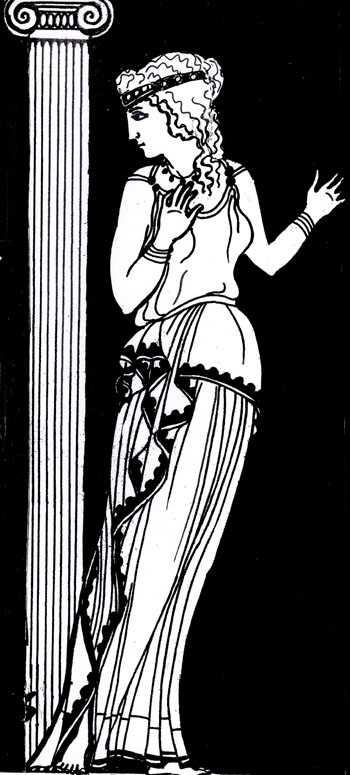 In May 2011 two of us took part in a play-reading in Greek of Euripides 'Helen' with the Classical Association of Scotland Edinburgh & SE branch. I immediately thought that it was a marvellous play, particularly because Helen is such a drama queen and Menelaus such a stodgy foil to her, and I really wanted to put on a performance.
Athens of the North
As no suitable amateur company existed here in Edinburgh I have formed my own, Athens of the North, just to put on 'Helen'. The director, Andy, and I chose Andrew Wilson's translation because it seems accessible to a modern audience and brings out the humour of the play.
Music and casting
Since it seemed important to be to some extent authentic and to have a chorus which would dance, chant and sing like an Athenian tragic chorus, the first problem was to write some music. A local composer agreed to start with one choral ode, but ill health has impeded him, so the rest of the music has been adapted from ancient Greek hymns and songs, or else composed, by me. This was quite difficult as the choral odes in translation have not been written with setting to music in mind, but between us we have managed something. All the singing is in unison and accompanied by a cor anglais (in place of an aulos). Next we had to find some actors or singer-actors who could take on Greek tragic roles. Fortunately we now have an almost complete cast of experienced local actors.
Euripides' Helen
Euripides produced his play 'Helen' in the spring of 412 BC in Athens, during the City Dionysia, the competitive dramatic and religious festival in honour of Dionysus. It was probably written in haste after the calamitous end of the Athenian expedition to Sicily in 413, at a time when Athens had been at war with Sparta for 19 years.
The story is based an the alternative myth recounted by Stesichorus of Sicily in the sixth century BC and also by Herodotus in his Egyptian history. Although Euripides' play is formally a tragedy it goes outside the boundaries of genre: we might call it a romantic comedy. However it contains serious themes concerning the futility of war and the distinction between illusion and reality. As the most beautiful woman in the world was Helen human or a goddess? She was worshipped as a goddess at Sparta, Troy and in Egypt, amongst other places. Was it Helen or a phantom who caused the Trojan War, which saw so much death and destruction? Euripides urges us to think about all this while amusing us with his characterisation of Menelaus and even Helen herself.
Many thanks to Sir Gerald Elliot for generously sponsoring this production.
Credits
Music composed by Jamie Dunnett, and composed and adapted from ancient Greek sources by Inga Mantle. Cor anglais: Iain Thompson
Director Andy Fraser
Producer Inga Mantle
Choreography Lydia Mantle
Set design and props Anne Seaton
Costume Design Helen Berrington
Cast
Helen Fiona Main
Teucer Chris Drew
Chorus Leader Walter Thomson
Menelaus Neil French
Old Woman Alison Carcas
First Messenger Robert Seaton
Theonoe Susan McNaught
Theoclymenus Matthew Stanhope
Second Messenger Michael Scott
Dioscuri Robert Seaton and Alison Carcas